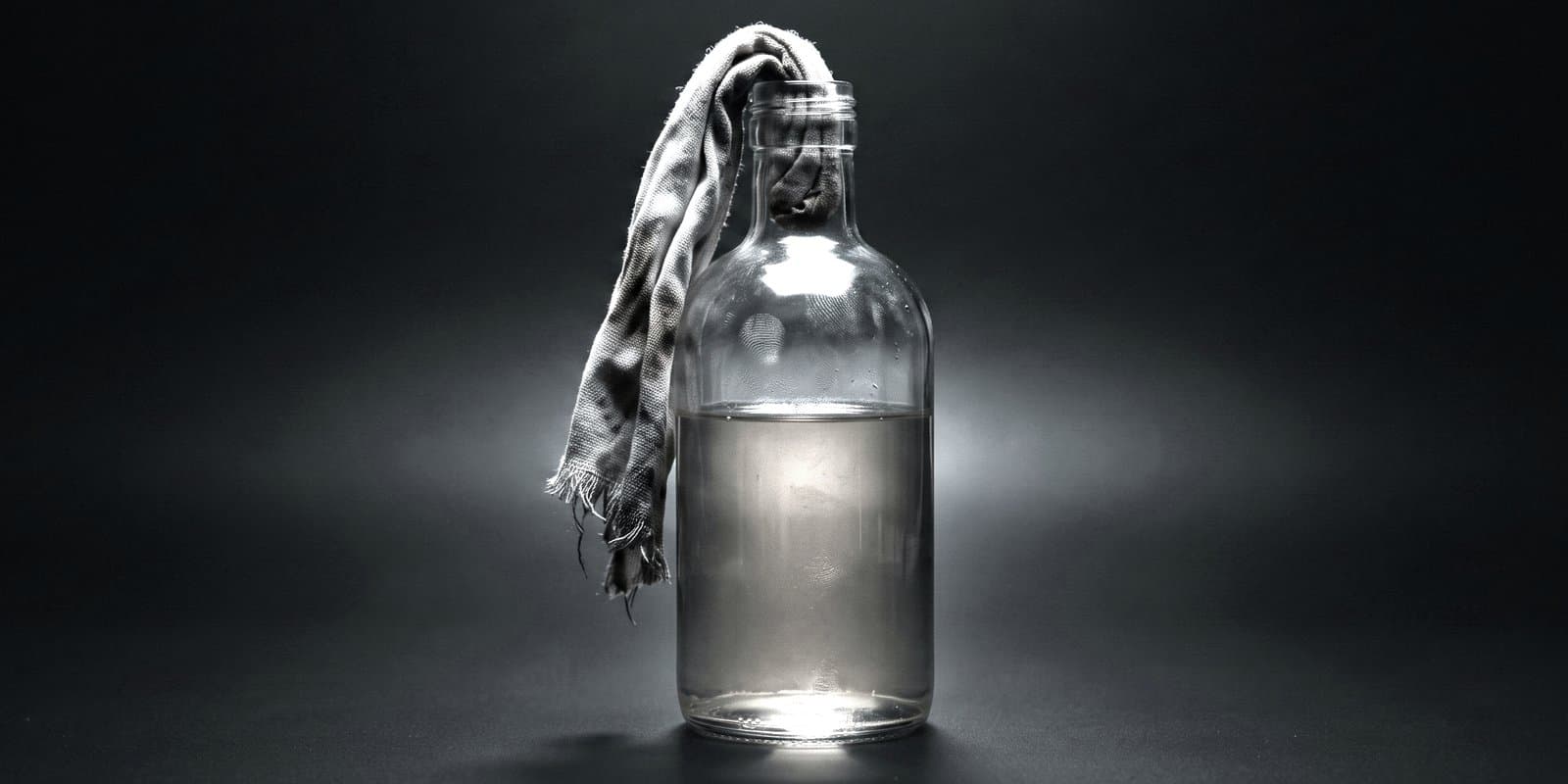
Molotov
A bottle of petrol and a rag has no attack table and no columns. There is no attack roll at all: the only roll is the placement maneuver that decides where the bottle breaks, and everyone inside the radius takes the critical for it RMUCore Law 9.3 (p. 164), the worked example: a thrown oil lamp is given an A critical out to twenty feet, one size up on the centre target if one is aimed for, resolved with no attack table at all. The same passage sets improvised thrown incendiaries of that kind at a 01-04 fumble where spells fumble on 01-02. Nothing is read against armor either — against burning fuel a vest counts for as much as a shirt.
| Molotov | |
|---|---|
| Throw | 10' / 20' / 30' / 40' / 50' |
| Radius | 20', from where it broke |
| As it breaks | an A Heat critical |
| Whoever you aimed it at | a B Heat critical instead |
| Each further round in it | one severity worse than the last, up to E |
| The fuel burns for | 4 + 1d10 rounds (25 to 70 seconds) |
| And | sets what it touches alight |
| Fumble | 01-04 |
Placing it. The throw is a Percentage Maneuver on Ranged Weapon: Thrown — the whole skill bonus, not the ranks. It is the same maneuver the fragmentation grenade uses; only the increment differs:
\(d100_{OE} + Thrown + Modifiers\)
Three things move it: how far you threw, how precise the throw has to be, and how fast you threw it — -25 for each action point under the three a ranged attack wants.
| Range | Reaches | Modifier |
|---|---|---|
| Short | 10' | +0 |
| Medium | 20' | -10 |
| Long | 30' | -25 |
| Extreme | 40' | -50 |
| Absurd | 50' | -100 |
| Difficulty | Modifier | What you are throwing at |
|---|---|---|
| Easy | +20 | an open doorway you are standing in front of |
| Light | +10 | a room through its open door, from the street |
| Medium | +0 | a group spread across a room's width — the book's own example |
| Hard | -10 | a window, a stairwell, one named person in that group |
| Very Hard | -20 | an open car window, or a moving vehicle at all |
The ladder is RMU's own and runs further in both directions; these are the rungs a thrown bottle actually lives on RMUCore Law Table 5-1 (p. 125) prints the difficulty ladder in full: Casual +70, Simple +50, Routine +30, Easy +20, Light +10, Medium 0, Hard -10, Very Hard -20, Extremely Hard -30, Sheer Folly -50, Absurd -70, Nigh Impossible -100. The difficulties and their modifiers are RMU's; which throw earns which is this conversion's, anchored to the worked example at 9.3 (p. 164), where catching a spread-out group with a thrown lamp is set at Medium.
100 or more puts the bottle where you meant it. Anything less and it scatters: take half the distance you threw, and it breaks off target by the percentage of that you fell short of 100, in a direction rolled on a d12 read as a clock face with twelve downrange (Fig. 1) RMUCore Law 9.3 (p. 164): placement is a Percentage Maneuver with Ranged Weapon: Thrown at a difficulty set by the precision wanted; 100 or more places it, and anything less is displaced by (100 - result)% of half the distance thrown. RAW randomises the direction with a d6 for hex facings, a d8 for a square grid or a d12 for a clock face - this conversion uses no grid, so the clock is the only one of the three that applies, and reading twelve as the line of the THROW rather than the target's facing is this conversion's. Table 8-1 (p. 154) prices a Ranged Attack at 1-3 AP and 8.1 costs -25 for each AP under an action's maximum. Hanging the range band on the placement maneuver rather than on an attack roll is this conversion's as well, an area attack having no attack roll to modify.
Fig. 1 A bottle through the window
Walls stop it. The radius is measured from where the bottle broke, and burning fuel runs along a floor rather than through masonry: a wall between you and the fire keeps you out of it, and an open door or window lets it through into whatever is on the other side RMUCore Law 9.3 (p. 164) has shields and cover apply to an area attack where they lie between its centre point and the defender, so an intervening barrier is RAW - it is the sentence the Combat page cites for blast cover. Making it ABSOLUTE here is this conversion's, as is the fire coming through an opening. The two are read differently because the mechanics differ: fragmentation has an attack roll for cover to subtract from, and half a brick wall is worth +70 off it, while a Molotov has no roll at all - there is nothing for a modifier to attach to, so the wall either keeps the burning fuel off you or it does not.
How long it burns, and how much worse it gets. The fuel is spent in 4 + 1d10 rounds — twenty-five to seventy seconds — and it does not stay as mild as it started. The splash is an A. Every further round a body spends in the burning fuel comes one severity worse than the last — B, then C, D, and E, which is as far as the Heat table goes and as far as this climbs. Whoever it was aimed at starts at B and reaches the top a round sooner.
The count is per person, from the round they first entered it: get out and it stops, go back in for someone and it begins again at A. What the fuel set alight goes on burning after the fuel itself is gone, and is no longer measured by the radius or by this rule — that is ordinary fire, and it is ruled there RMUTwo passages of Core Law rule this and they do not agree, so the ramp runs between them rather than picking one. 9.3 (p. 164) gives a thrown oil lamp an A critical over its radius - that is the splash. 15.3, Extreme Temperatures (p. 267), rules that a character takes a Heat critical EVERY ROUND spent in an extreme environment, and that heat which bathes the target's entire body inflicts an E critical or worse; Table 15-3 puts anything above 550C at E, and a petrol fire burns far hotter. So the per-round critical is RAW and both endpoints are RAW; one severity per round between them is this conversion's, as is counting it per person from the round they entered. The cap is the Heat Critical Strike Table (p. 229), which ends at E - RMU's F and G are an E plus a second critical of the table's OTHER listed type, and this weapon has no second type. The DURATION is invented outright: neither book gives a thrown incendiary one. RMU's round is five seconds, so 4 + 1d10 is 25 to 70. What the fuel leaves alight is fire endured, which Core Concepts rules by how much of the victim is in it.
Heat criticals are RMU's own table RMUHeat Critical Strike Table, Core Law p. 229. RMU's own table, read from the book. There is no fuse: it breaks and lights in the same instant, so nobody gets the round a grenade allows for moving, going flat, or throwing it back — that round, and the rest of what the other explosives share, is on Combat. A fumbled throw never leaves your hand — the bottle breaks at your feet, and you are inside the radius like anyone else RMUCore Law 9.3 gives improvised area weapons a 01-04 fumble and no result for it. The bottle breaking in the thrower's hand is this conversion's, matched to the fumbled grenade on the Combat page; with no fuse to run there is nothing to do about it, so the thrower takes the same A Heat critical as anyone else caught in the radius.
The fire is the weapon; the critical is the excuse. Burning is Aggravated for the Kindred and goes on being Aggravated for as long as it burns, which makes a two-euro bottle one of the few things a mortal can throw at a vampire and mean it.